
Last updated June 21, 2026
Seasonal Garage Door Care for Fort Lauderdale: Year-Round Homeowner’s Guide
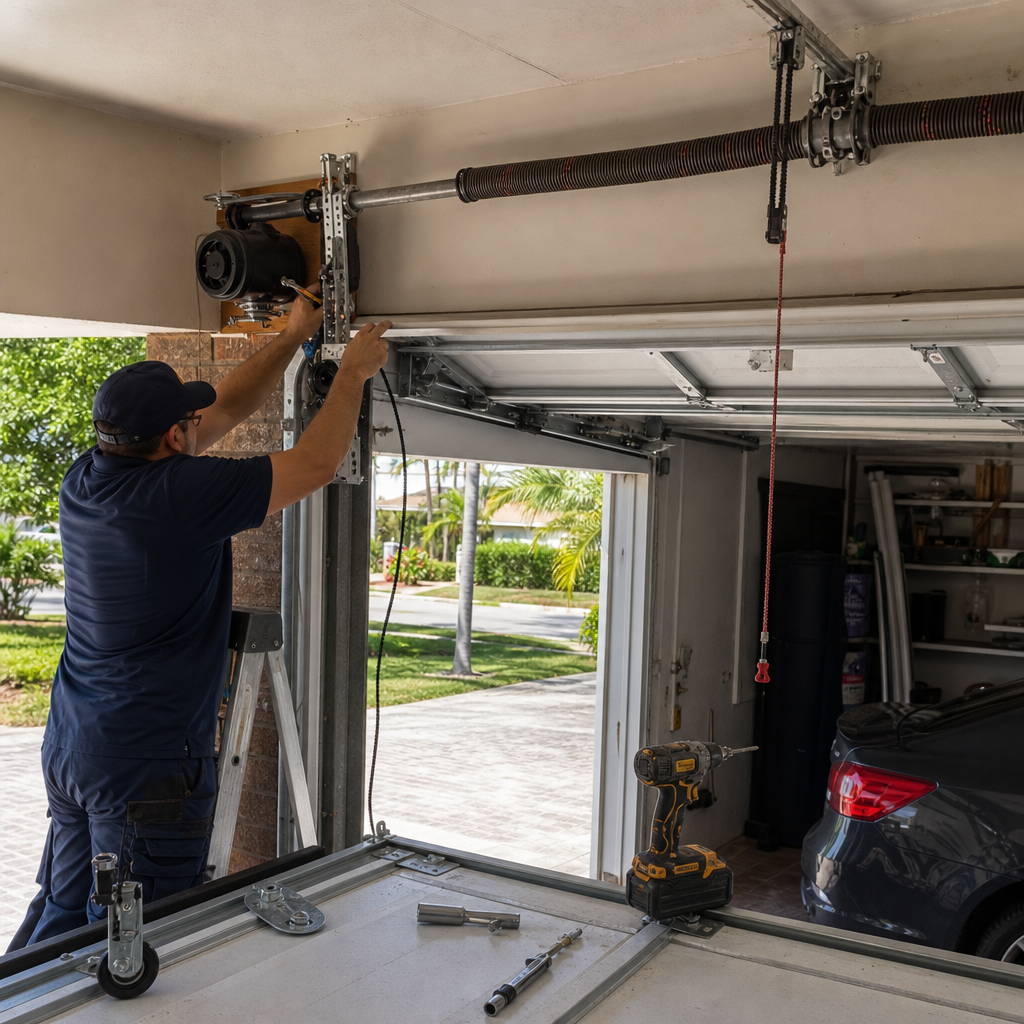
The week after a major storm is the busiest stretch of my year — and 80% of those calls are for damage that a focused two-hour pre-season inspection would have prevented or reduced. What surprises most Fort Lauderdale homeowners is that their garage door owner’s manual was almost certainly written for a climate nothing like ours. The four-season maintenance calendar printed on that sheet assumes cold winters, dry springs, and mild summers. None of that applies here. This guide gives you a maintenance rhythm built around the two seasons that actually define life in Fort Lauderdale: hurricane season and everything else — and what to do during each one to protect one of the largest, most mechanically complex openings in your home.
Quick Answer
Garage door maintenance in Fort Lauderdale runs on a two-season calendar: a critical pre-hurricane inspection in late April or May, and a dry-season service pass between November and March. The biggest local threats are wind-load panel failure during storms, thermal shutdown of openers from summer heat, and salt-air corrosion that quietly destroys hardware year-round. A homeowner who runs through both seasonal checklists will prevent the majority of the emergency calls we handle every year.
Table of Contents
- Fort Lauderdale Has Two Seasons — Not Four
- May Pre-Hurricane Prep: The Inspection That Matters Most
- Post-Storm Protocol: What to Check Even When the Door Looks Fine
- How Summer Heat Degrades Your Opener and Rollers
- Humidity, Swelling, and Seasonal Binding
- Dry Season Tasks: November Through March
- Year-Round Salt-Air Corrosion: The Silent Killer
- Common Mistakes to Avoid
- When to Call a Professional
- Frequently Asked Questions
- The Bottom Line
Fort Lauderdale Has Two Seasons — Not Four
Most garage door guides open with a spring/summer/fall/winter breakdown. That framework is useless in South Florida. What Fort Lauderdale actually gives you is this: a wet, hot, storm-active season running roughly June 1 through November 30, and a comparatively mild, drier stretch from December through May. Your maintenance calendar should mirror that reality exactly.
The wet season brings the obvious threats — named storms, tropical squalls, sustained wind events — but it also delivers 90°F+ ambient temperatures, afternoon heat index readings that push garage interiors well past 110°F on a west-facing exposure, and daily humidity that hovers between 75% and 90%. All three of those conditions stress garage door hardware in specific, measurable ways.
The dry season from November through March is when Fort Lauderdale gives you the gift of workable weather. Temps drop into the 60s and 70s, humidity backs off, and you can actually spend time in your garage without losing a pound of water weight. That window is your maintenance season — the time to lubricate, inspect, adjust, and replace anything that took a beating from June through November.
The transition month — May — is the single most important month on your calendar. It sits between the manageable dry season and the opening of hurricane season, which means it’s your last realistic opportunity to get the door ready before the storms arrive. We’ll cover that in detail next.
May Pre-Hurricane Prep: The Inspection That Matters Most
In Fort Lauderdale, “hurricane prep” usually brings to mind shutters and generators. Your garage door deserves equal attention — it’s the largest opening in most homes and, under wind load, it can fail catastrophically if panels, bracing, or hardware aren’t up to the task. Here’s the full pre-hurricane inspection sequence we recommend every May:
- Check your door’s wind-load rating and bracing hardware. Florida Building Code Section 1609 requires garage doors in our wind zone to meet specific design pressure ratings. If your door was installed before 2002 or you’ve never seen documentation of its wind-load compliance, that’s the first thing to establish. Look for horizontal bracing struts across the back face of each panel — on doors 16 feet wide or wider, there should be at least two, and they should be bolted firmly, not just clipped.
- Inspect every panel for micro-fractures, dents, and delamination. Aluminum and steel panels that took minor impacts during previous seasons may look cosmetically fine but have lost structural integrity. Press firmly on the center of each panel — it shouldn’t flex more than about half an inch. Significant give indicates a compromised panel that could fail under wind pressure.
- Test the bottom seal and side weatherstripping. Water intrusion during a storm typically enters at the bottom seal first. Run your hand along the bottom edge of the door in the closed position — if you feel daylight or the seal is cracked and stiff, replace it before June.
- Verify your opener has a battery backup. Power outages during storms are near-certain in many Fort Lauderdale neighborhoods, particularly in areas like Tarpon River and Sailboat Bend that see older infrastructure. LiftMaster and Chamberlain units from roughly 2012 onward have battery backup options; if yours doesn’t, it’s worth upgrading before storm season opens.
- Manually disengage and operate the door by hand. With power off, pull the red emergency release cord and lift the door manually. It should move smoothly with moderate effort. If it binds, drops quickly, or requires two hands and a grunt, your springs are weakened and you don’t want to discover that during a power outage at 11 PM the night before a storm.
- Lubricate springs, rollers, and hinges. Use a dedicated garage door lubricant — not WD-40, which is a solvent, not a lubricant, and evaporates quickly in South Florida heat. Work the product into the coils of the torsion spring, onto each roller stem, and through every hinge pivot point.
This inspection takes about two hours for a handy homeowner. If anything flags — hardware that’s corroded, panels that flex too easily, a door that won’t balance — get it addressed in May, not in July when we’re already booked solid after the first named storm of the season.
Post-Storm Protocol: What to Check Even When the Door Looks Fine
This is the section most homeowners skip, and it’s why we get so many calls in the weeks after a storm rather than immediately following it. A near-miss — a storm that passes nearby without direct impact — can still subject your door to sustained lateral wind pressure that shifts track alignment by fractions of an inch. That shift won’t be visible to the naked eye, but it will cause the door to bind, skip a roller, or overtax the opener motor over the following weeks.
After any storm event — even one that didn’t seem severe — run through this post-storm check before resuming normal use:
- Visually inspect the tracks from top to bottom on both sides. Look for any section that appears bent, pulled away from the wall, or no longer parallel to the door edge. Even a quarter-inch gap or bend is significant.
- Check all lag bolts and mounting hardware. The vertical tracks are anchored to the door frame with lag bolts. Wind vibration works these loose over time. Tug the track gently — there should be zero movement.
- Operate the door slowly on manual mode first. Before reconnecting the opener, lift and lower the door by hand twice. Listen for scraping, feel for resistance, and watch whether the door sits level in the closed position. If the floor gap is noticeably larger on one side than the other, the tracks have shifted.
- Inspect the torsion spring above the door. If it has a visible gap in the coil — a separation of a half-inch or more — the spring broke during the storm event. Do not attempt to operate the door with a broken spring.
- Check the opener motor head for water intrusion. In garages where the ceiling isn’t well-sealed — common in older homes in neighborhoods like Edgewood and Progresso — rain can infiltrate around the motor unit. If you see moisture inside the light lens or on the logic board, do not power the unit back on without professional inspection.
- Test all safety sensors after reconnecting power. The photoelectric sensors at the base of the tracks are low-mounted and vulnerable to debris, shifting, and misalignment. Pass your hand through the beam path — the door should reverse immediately on contact. If it doesn’t reverse, or if the sensor LEDs are blinking, realign them before using the door.
How Summer Heat Degrades Your Opener and Rollers
Fort Lauderdale’s summer heat isn’t just uncomfortable — it’s mechanically destructive in specific ways that most homeowners don’t think about until something fails.
First, consider the radiant heat load on a west-facing garage door. By 3 PM on a July afternoon, the surface temperature of a steel door facing west can reach 140–160°F. The air inside an uninsulated Fort Lauderdale garage on that same afternoon commonly hits 115–120°F. Most residential garage door openers — including popular LiftMaster and Genie models — have a thermal protection circuit that shuts the motor down when internal temperatures exceed roughly 110°F. If your opener stops working on the hottest afternoons and resumes in the evening, thermal shutdown is the likely diagnosis, not a mechanical failure.
The fix involves better garage ventilation (a ceiling vent or attic fan helps significantly), parking in the shade before entering so you’re not cycling the door during peak heat, and — if thermal shutdowns are frequent — considering an insulated door that reduces interior temperature by 10–15°F. Clopay and Amarr both make insulated steel doors with polyurethane cores that perform meaningfully better than single-skin panels in South Florida heat.
Second, plastic rollers degrade faster here than anywhere on the East Coast. The combination of sustained high temperatures and UV exposure that seeps into garages with gaps around the door frame causes standard nylon rollers to become brittle within three to four years. When a roller cracks or flattens, the door starts to skip, bind, or run noisily. We replace a significant number of roller sets every summer in Fort Lauderdale — particularly on doors installed in the mid-2010s that are now past their component lifespan. Steel rollers with sealed ball bearings are a better long-term investment for our climate than standard nylon, and they last two to three times as long.
Humidity, Swelling, and Seasonal Binding
If your garage door runs smoothly in February but drags or binds in August, seasonal expansion is almost certainly the cause. This affects two door types in particular: real wood doors (still common on custom homes in Victoria Park and Harbor Beach) and older steel-backed doors with foam insulation panels that absorb ambient moisture.
Solid wood doors — Wayne Dalton and Clopay both offer wood composite lines that are popular in Fort Lauderdale’s historic neighborhoods — can expand enough during peak summer humidity to reduce track clearance by an eighth of an inch or more. That’s enough to cause the door to drag against the weatherstrip or bind at the corners. The right response is a seasonal clearance adjustment: the track mounting brackets can be loosened and the track shifted slightly outward to accommodate the expanded door width, then returned to the tighter position in November when the door contracts.
For steel doors with foam insulation cores, the failure mode is different. The insulation panel itself absorbs moisture and can delaminate from the steel skin over time, creating a bubble or warp in the panel face. Once this happens, the panel won’t sit flush and the door loses its insulating value as well as its structural uniformity. A panel in this condition will show a visible bow when you stand at the side of the door and look along its face. Delaminated panels should be replaced rather than lived with — the warping typically worsens each subsequent summer.
Dry Season Tasks: November Through March
The stretch from November through March is when Fort Lauderdale cooperates. Humidity drops, temperatures become genuinely pleasant, and your garage is a workable space. This is your window for every maintenance task that requires time, attention, and comfort.
Here’s what belongs on your dry-season list:
- Full lubrication service. Springs, rollers, hinges, and the drive rail (for chain or belt-drive openers). Use a product specifically formulated for garage doors — we recommend White Lithium Grease for metal-to-metal contact points and a silicone-based spray for the bottom seal and weatherstripping.
- Safety reversal test. Place a 2×4 flat on the floor under the center of the door and trigger the close cycle. The door must reverse within two seconds of contact. If it doesn’t, the force sensitivity setting needs adjustment — this is a critical safety function, not an optional test.
- Photo-eye sensor alignment check. Wipe the sensor lenses clean (salt dust accumulates on them year-round here), verify both LEDs are solid (not blinking), and confirm the door reverses when the beam is broken.
- Balance test. Disconnect the opener, lift the door manually to waist height, and let go. A properly balanced door stays at that height. If it drifts up, the springs are over-tensioned; if it drops, they’re under-tensioned. Either condition should be addressed by a professional — spring tension is not a DIY adjustment.
- Inspect cables and bottom brackets. Look for frayed cable strands and any bracket that looks bent, cracked, or missing a bolt. Both are load-bearing components and both should be replaced before they fail.
- Address corrosion found during the storm season. Clean rust spots with a wire brush, treat with a rust converter product, and repaint bare metal before the humidity comes back in June.
- Test opener battery backup (if equipped). Disconnect shore power and operate the door on battery alone. LiftMaster’s battery backup units are rated for roughly 20 cycles on a charge — if yours is operating for fewer, the battery is degrading and should be replaced ahead of the next storm season.
If you can only do one maintenance pass per year in Fort Lauderdale, make it the dry-season pass. It sets up the door to survive whatever the following wet season delivers.
Year-Round Salt-Air Corrosion: The Silent Killer
This section applies to every Fort Lauderdale homeowner, but it applies most urgently to anyone within about a mile of the Intracoastal or the Atlantic — neighborhoods like Lauderdale-by-the-Sea, Rio Vista, and Coral Ridge Isles see accelerated hardware deterioration that simply doesn’t happen in inland communities like Tamarac or Margate.
Salt air attacks steel hardware the way humidity attacks wood — silently, progressively, and always from the inside out. By the time you see red rust on a hinge or spring, the corrosion has typically already compromised the steel’s cross-section. Torsion springs on coastal properties routinely fail at 40,000–50,000 cycles rather than the 80,000–100,000 cycles you’d expect in a drier, inland climate. Hardware that might last eight to ten years in a non-coastal environment can fail in four to six years near the water.
Mitigation steps that actually work in Fort Lauderdale:
- Use stainless steel or galvanized hardware wherever possible — especially for bottom brackets, hinges, and track mounting bolts.
- Keep the door’s finish intact. Chips and scratches in the painted surface of a steel door expose bare metal directly to salt-laden air. Touch up any damage within the same season it occurs.
- Wipe down visible metal hardware with a lightly oiled rag every three to four months — a thin coat of oil creates a barrier between the hardware and the air.
- Consider a powder-coated or hot-dip galvanized spring upgrade. Several manufacturers now offer springs with corrosion-resistant coatings specifically marketed for coastal climates — they’re worth the modest price premium if you’re within a mile of open water.
Common Mistakes to Avoid
- Using WD-40 as a garage door lubricant. WD-40 is a water displacer and light solvent — it evaporates in South Florida heat within days and actually strips existing lubricant from the parts. Use a dedicated garage door lubricant or white lithium grease. We correct this mistake on a large percentage of the service calls we run in Fort Lauderdale.
- Skipping the pre-hurricane inspection because the door “seems fine.” A door that operates normally in April can still have micro-fractured panels, loose bracing hardware, or a spring that’s down to its last few thousand cycles. “Seems fine” and “will survive a Category 1 wind event” are two different standards entirely.
- Painting over a garage door without removing hardware first. This is surprisingly common in Fort Lauderdale, where homeowners recoat doors every few years to fight UV and salt damage. Painting over hinges, rollers, and spring brackets locks moving parts together and accelerates corrosion under the paint layer rather than preventing it.
- Ignoring a door that’s slow but still working. A door that takes noticeably longer to open than it did six months ago is telling you something: worn springs, damaged rollers, or an opener working outside its rated load. Acting on that signal costs $150–$300 in most cases. Waiting until it fails completely can mean a broken spring during a storm, a car trapped in the garage, or an opener motor that burns out from sustained overload.
- Adjusting spring tension without the right tools and training. This mistake lands people in emergency rooms. Torsion springs store enormous mechanical energy — a standard double-door spring holds roughly 100 foot-pounds of torque. Adjustment requires winding bars and the knowledge of how many turns are required for the specific door weight. It’s not a YouTube project.
- Installing a non-Florida-code-compliant replacement door without checking the permit requirement. In Fort Lauderdale, garage door replacements typically require a permit, and the replacement door must meet the wind-load design pressure requirements for the wind zone. Installing a door that doesn’t meet code — whether you bought it at a big-box store or from an unlicensed contractor — can create insurance and liability issues if the door fails during a storm event.
- Assuming the opener is the problem when the door is the problem. In our experience, the majority of calls that open with “my opener stopped working” turn out to be a door that’s out of balance, binding in the tracks, or fighting a broken spring — not a failed opener. Replacing an opener before diagnosing the mechanical condition of the door is money spent in the wrong direction.
When to Call a Professional
Run the DIY maintenance tasks described in this guide — they’re well within reach for most homeowners. But call a professional when you encounter any of the following:
- A visible gap in the torsion spring coil, or a spring that appears to have snapped into two sections
- Frayed, kinked, or snapped lift cables
- A door that won’t stay at waist height when released on manual mode (failed balance)
- Tracks that are visibly bent, pulled away from the wall, or no longer parallel
- Any post-storm condition where the door won’t fully close or shows binding that wasn’t present before the storm
- An opener that makes grinding, humming, or clicking sounds without moving the door
- Safety reversal that fails the 2×4 test — this is a liability and safety issue, not a cosmetic one
For any of these situations, David Martinez and the team at Garage Door Repair in Fort Lauderdale at Horizon Garage Door Repair Oakland Park are available for same-day service and emergency calls. Estimates are free. Call (561) 933-5484 — you’ll get a straight answer about what the door needs and what it costs before any work begins.
Frequently Asked Questions
How often should I service my garage door in Fort Lauderdale?
Twice a year is the right rhythm for Fort Lauderdale: once in May as a pre-hurricane inspection, and once between November and January as a dry-season maintenance pass. Homes within a mile of the Intracoastal or the Atlantic should add a quick hardware wipe-down and visual corrosion check every three to four months, given the accelerated salt-air exposure in those neighborhoods. Call (561) 933-5484 if you’d prefer to have a professional run either pass — estimates are always free.
What’s the most common garage door problem in Fort Lauderdale after a storm?
Track misalignment is the most common issue we see after storm events — particularly after near-miss storms that homeowners assume caused no damage. Sustained lateral wind pressure shifts tracks by fractions of an inch that are invisible until the door starts binding or skipping a roller in the weeks following the storm. Broken torsion springs are the second most common post-storm finding, particularly on doors with aging hardware that was already near end-of-life entering storm season.
Can Fort Lauderdale’s heat cause my garage door opener to stop working?
Yes — and this is one of the most common summer service calls we handle. Most residential openers, including popular LiftMaster and Genie models, have a thermal protection circuit that shuts the motor down when internal temperatures exceed roughly 110°F. A west-facing garage on a July afternoon in Fort Lauderdale can easily exceed that threshold by mid-afternoon. If your opener fails during the hottest part of the day and resumes in the evening, thermal shutdown is the likely cause — not a mechanical defect. Improving garage ventilation and considering an insulated Garage Door Installation in Fort Lauderdale are the two most effective long-term solutions.
Does Fort Lauderdale require a permit to replace a garage door?
Yes, in most cases. The City of Fort Lauderdale and Broward County require permits for garage door replacements because the new door must be verified to meet Florida Building Code wind-load design pressure requirements for the applicable wind zone. Skipping the permit process doesn’t just create a code violation — it can create insurance complications if the door fails during a storm event. Always confirm permit requirements with your contractor before installation begins, and ask to see documentation of the door’s wind-load rating. We handle all permitting as part of our Garage Door Installation in Fort Lauderdale process.
How long do garage door springs last in South Florida’s climate?
Standard torsion springs are rated for roughly 10,000 cycles in typical conditions — that’s about seven to ten years for an average household. In coastal Fort Lauderdale neighborhoods, salt-air corrosion shortens that lifespan meaningfully: springs within a mile of open water commonly fail at 40,000–50,000 cycles rather than the rated 80,000–100,000. If your door is more than five years old and you live near the Intracoastal or the Atlantic, spring condition should be part of your annual inspection. Call (561) 933-5484 for a free assessment — a spring replacement scheduled on your terms costs a fraction of an emergency call.
What should I do if my garage door won’t open after a power outage during a storm?
If your opener has a battery backup (common on LiftMaster and Chamberlain units from 2012 onward), it should operate normally during an outage — verify that the backup is charged as part of your dry-season maintenance. If you don’t have battery backup, locate the red emergency release cord hanging from the opener rail and pull it firmly downward. This disengages the trolley from the drive mechanism and allows you to lift the door manually. If the door won’t lift manually with moderate effort, there’s a mechanical issue — a broken spring or failed cable — and you should not force it. Call (561) 933-5484, and consider upgrading your Garage Door Opener in Fort Lauderdale to a battery-backup model before next storm season.
The Bottom Line
Fort Lauderdale puts more stress on a garage door than almost any climate in the continental United States — between storm-season wind loads, summer heat that regularly drives garage interiors past 110°F, year-round humidity that swells wood and rusts steel, and salt air that quietly destroys hardware near the water. The homeowners who avoid expensive emergency calls are the ones who run two focused maintenance passes per year: a pre-hurricane inspection every May and a dry-season service every November through January. Stay on top of lubrication, corrosion, balance, and safety reversal, address any post-storm anomalies before they compound — and when something exceeds your comfort level, call a professional before a small problem becomes a crisis.
Over 1,200 Fort Lauderdale neighbors have called Horizon Garage Door Repair Oakland Park when the door needed attention — and found David Martinez showing up personally, diagnosing the problem honestly, and standing behind the work. If this guide raised a question about your specific door, or if you’d like a free pre-hurricane inspection before June 1, call (561) 933-5484. You’ll get a straight answer from someone who knows these doors and this climate. Horizon Garage Door Repair Oakland Park home is ready to help whenever you need it.
Written by David Martinez, Owner & Lead Technician at Horizon Garage Door Repair Oakland Park, serving Fort Lauderdale since 2014.