
Last updated June 21, 2026
The Complete Guide to Garage Door in Fort Lauderdale
Salt-laden air off the Atlantic can corrode a standard torsion spring in under 18 months — a timeline most homeowners don’t learn until they’re already stranded with a door that won’t open on a Tuesday morning. In Fort Lauderdale, the rules for garage doors are genuinely different from everywhere else. The combination of coastal humidity, year-round UV intensity, hurricane season, and Broward County code requirements creates failure patterns that no generic national guide addresses. This guide was built around what actually breaks here — the materials that survive this climate, the codes that govern what you can install, and the decisions that separate a 5-year system from a 20-year one.
Quick Answer
In Fort Lauderdale, a properly spec’d garage door system — one built for South Florida’s coastal humidity, salt air, and hurricane wind loads — costs more upfront but dramatically outlasts big-box alternatives. Broward County requires impact-rated or hurricane-braced doors on new installations, and HOA approval plus Miami-Dade/Broward product approval numbers are mandatory before you buy. Getting the material, hardware grade, and opener class right the first time is the single biggest factor in long-term performance here.
Table of Contents
- How Fort Lauderdale’s Climate Destroys Average Garage Doors
- Which Door Materials Actually Hold Up Here
- Hurricane Impact Ratings and Broward County Code Requirements
- Choosing the Right Opener for South Florida Conditions
- The True Cost of Ownership in Fort Lauderdale’s Market
- HOA Approval and Product Approval Numbers — What to Know First
- A Fort Lauderdale Maintenance Schedule That Actually Works
- Common Mistakes to Avoid
- When to Call a Professional
- Frequently Asked Questions
- The Bottom Line
How Fort Lauderdale’s Climate Destroys Average Garage Doors
Most garage door manufacturers engineer their products for national averages — which means they’re calibrated for a climate that doesn’t exist in Fort Lauderdale. Here, we’re dealing with three simultaneous stressors that compound each other: salt air from the Atlantic, year-round humidity averaging above 75%, and UV radiation intensity that exceeds nearly every other major U.S. city.
Standard galvanized torsion springs — the type that ships on the vast majority of doors sold at national chains — begin showing surface corrosion within 6–12 months of installation in coastal ZIP codes like 33304, 33305, and 33316. By 18 months, that surface rust has worked into the coil gaps. By 24–30 months, you’re looking at a fatigue fracture. We’ve replaced springs in Rio Vista and Victoria Park that failed in under two years, installed by companies that simply spec’d a standard spring without accounting for the salt exposure two blocks from the Intracoastal.
Cables are the second casualty. Standard steel cables develop micro-pitting from salt corrosion that isn’t visible until the cable is already compromised. Galvanized cables with a heavier zinc coating, or stainless steel cables, are the correct specification here — not a premium upgrade, just the right part for the environment.
Bottom seals and weatherstripping degrade faster too. The combination of UV, ozone (elevated near the coast), and heat cycling causes rubber compounds to harden and crack within 2–3 years on a south-facing door, versus the 5–7 years you’d see in an inland climate. In neighborhoods like Coral Ridge or Nurmi Isles, where garage doors often face south or west, this timeline is even shorter.
Which Door Materials Actually Hold Up Here
Material selection is the most consequential decision a Fort Lauderdale homeowner makes when buying a garage door. Here’s how the three primary options perform in this specific climate:
Steel (24-Gauge and Heavier)
Steel remains the most popular choice, but gauge matters enormously. Standard builder-grade doors are 27- or 28-gauge steel — thin enough that a single dent from storm debris can breach the paint layer and start the corrosion clock. In Fort Lauderdale’s market, we recommend nothing lighter than 24-gauge for a primary garage door, and 22-gauge for any home within half a mile of the water. Clopay’s steel doors with their factory-applied baked-on primer and polyurethane foam core hold up notably well here; Wayne Dalton’s 8000 and 9000 series are also well-specced for coastal environments when ordered with appropriate finishes.
Aluminum
Aluminum doesn’t rust, which is a genuine advantage in Fort Lauderdale. The tradeoff is dent resistance — aluminum doors in lighter gauges can dimple from hail or windblown debris. For homes near the beach in areas like Lauderdale Beach or Harbor Beach, a heavier-gauge aluminum door with a marine-grade anodized finish is a strong choice. Amarr manufactures aluminum doors specifically rated for coastal applications that perform well here.
Fiberglass and Composite
Fiberglass panels don’t corrode or rust, and they resist the UV yellowing that plagues cheaper materials. The weakness is impact resistance — a fiberglass door won’t meet Broward County’s wind-load requirements without a steel-reinforced subframe. For coastal homes where appearance and corrosion resistance are priorities, fiberglass with a steel frame is a legitimate option, but you need to verify the assembly carries an approved Florida Product Approval number.
Wood
Honest advice: wood garage doors require aggressive maintenance in Fort Lauderdale. Even cedar, the most moisture-resistant species commonly used, will delaminate, swell, and warp without annual sealing and quarterly inspection. Raynor and Clopay both manufacture wood composite doors that mimic the appearance with far better humidity resistance — they’re worth the extra investment in this climate.
Hurricane Impact Ratings and Broward County Code Requirements
This is the section most guides skip entirely — and it’s arguably the most important one for Fort Lauderdale homeowners.
Broward County adopted the Florida Building Code (FBC) requirements that mandate all new garage door installations meet specific wind-load ratings. For most residential properties in Fort Lauderdale, that means a door assembly rated for a minimum 140 MPH wind speed, though properties in higher-velocity zones closer to the coast may require 160 MPH or higher ratings. These aren’t suggestions — they’re permit requirements.
Every compliant door carries a Florida Product Approval number (FL#) issued by the Florida Building Commission. Before you purchase any door, that number needs to exist and be verifiable at the Florida Building Commission’s product approval database. If a contractor quotes you a door without being able to provide the FL# on the spot, that’s a hard stop.
There are two ways to achieve hurricane compliance:
- Impact-rated door systems — The door panel itself, the track, and the hardware are engineered as a single tested assembly. This is the cleanest solution and the one we recommend for full replacements.
- Braced systems — A standard door retrofitted with a horizontal bracing kit that brings it into wind-load compliance. This is a code-compliant option for existing doors in good condition, but the bracing must match the door’s specific dimensions and the assembly must carry its own FL# — you can’t mix and match components.
One detail that surprises homeowners: even a hurricane-rated door won’t perform correctly with an underpowered opener. A certified impact door may weigh 100–175 lbs more than a standard door. Your opener needs to be spec’d for that weight, or you’ll burn out the motor within a season and potentially void the door’s warranty.
Choosing the Right Opener for South Florida Conditions
Opener selection in Fort Lauderdale involves considerations that don’t apply in drier climates. The two biggest factors: humidity tolerance in the motor and drive system, and power rating for heavier wind-rated doors.
We work with LiftMaster, Chamberlain, Genie, Craftsman, and the other major brands daily. For Fort Lauderdale’s conditions, here’s what we’ve observed over 12 years of installs and service calls:
- Belt drive over chain drive — Belt drives are quieter, but more relevantly in this climate, they have fewer metal-on-metal contact points that can corrode. Chain drives in high-humidity environments need more frequent lubrication to prevent oxidation.
- DC motors with soft-start/soft-stop — These reduce mechanical stress on a heavier impact door. LiftMaster’s 87504 and Chamberlain’s equivalent DC-motor units are well-suited to heavier door weights common in South Florida hurricane-rated systems.
- Battery backup is not optional here — Fort Lauderdale loses power during tropical storms. An opener without battery backup means a manually operated door in the middle of a storm event. LiftMaster’s Backup Battery series and Genie’s standby battery systems are the openers we spec most often for new installations.
- Wi-Fi and smart connectivity — Genie and LiftMaster both offer myQ-compatible and Aladdin Connect systems. For rental properties in Fort Lauderdale, remote monitoring lets landlords confirm door status without being on-site.
For detailed guidance on openers specific to this market, our Garage Door Opener in Fort Lauderdale page covers brand comparisons, power ratings, and current pricing in depth.
The True Cost of Ownership in Fort Lauderdale’s Market
The price difference between a $799 big-box door and a properly spec’d $1,800 hurricane-rated system looks significant on day one. The math reverses by year three.
Here’s a realistic cost comparison for a standard two-car garage in Fort Lauderdale:
- Builder-grade steel door (non-rated), basic install: $850–$1,100 installed. Expected lifespan in coastal Fort Lauderdale: 6–10 years before significant hardware failure. Spring replacements likely at year 2 and year 4–5. Total 10-year cost including repairs: $1,400–$1,900.
- 24-gauge steel, impact-rated, professional install: $1,700–$2,800 installed depending on panel style and insulation. Expected lifespan: 18–25 years with normal maintenance. Spring replacement at year 8–10 using galvanized or stainless hardware. Total 10-year cost: $2,000–$3,100 — but you’re carrying a door with 10–15 more useful years ahead of it.
- Aluminum coastal-spec door: $2,200–$3,400 installed. Minimal corrosion-related maintenance. Best total cost of ownership for properties within two blocks of salt water.
Spring replacement alone in Fort Lauderdale currently runs $180–$340 for a standard torsion spring service. If you’re replacing springs every two years on a cheap door because the wrong hardware was installed, that cost adds up fast — and that’s before accounting for the inconvenience of an emergency call when the spring snaps at 7 AM.
For a full breakdown of repair and installation pricing in this market, see our page on Garage Door Repair in Fort Lauderdale.
HOA Approval and Product Approval Numbers — What to Know First
Fort Lauderdale has a high concentration of HOA-governed neighborhoods — from Coral Ridge Country Club Estates to Lauderdale Manors and the gated communities along the east side of Federal Highway. In virtually every one of them, replacing your garage door requires prior written approval from the HOA architectural committee, not just a building permit.
This is a step that contractors who work quickly and ask questions later will skip — leaving homeowners on the hook for fines and mandatory re-installation. Here’s what the approval process typically requires:
- Submit the manufacturer’s product spec sheet to your HOA architectural committee. This should include panel style, color, finish, and material.
- Confirm the Florida Product Approval number (FL#) is listed on the spec sheet. Your HOA board may not ask for this, but your building permit inspector will — and you want these to align.
- Get written approval before ordering. Lead times on impact-rated doors run 3–6 weeks. Getting a rejection after the door ships creates real problems.
- Pull the permit before installation. A Broward County building permit is required for new door installations. A competent contractor handles this — if a contractor suggests skipping the permit to save time, that’s a disqualifying flag.
- Schedule the inspection. Post-installation inspection closes the permit and confirms code compliance. This matters for your homeowner’s insurance and for resale.
A few HOAs in Fort Lauderdale maintain an approved product list. If yours does, start there — it eliminates back-and-forth with the committee and accelerates approval.
A Fort Lauderdale Maintenance Schedule That Actually Works
Generic maintenance guides say “lubricate your springs twice a year.” In Fort Lauderdale, that frequency isn’t enough. Here’s a climate-adjusted schedule based on 12 years of service calls in this market:
Every 3 Months
- Wipe down all metal hardware (hinges, rollers, brackets) with a dry cloth to remove salt film buildup.
- Apply a silicone-based spray or white lithium grease to torsion springs, roller stems, and hinge pivot points. Do not use WD-40 — it’s a solvent, not a lubricant, and it displaces the protective film you need.
- Inspect the bottom seal and side weatherstripping for cracking or hardening. In Lauderdale Beach and Coral Ridge, UV exposure hardens rubber seals faster than in inland neighborhoods — quarterly checks catch early deterioration before water intrusion starts.
Every 6 Months
- Test the door’s balance: disconnect the opener, manually lift the door to waist height, and release it. It should hold position within a few inches. Significant drift indicates spring tension imbalance — a technician call, not a DIY fix.
- Check cable condition visually for fraying, kinking, or rust spots. Any of these means cable replacement, not watchful waiting.
- Test the opener’s force settings and auto-reverse function using the manufacturer’s test procedure (usually a cardboard test on the floor). Heat and humidity can cause force drift over time.
Annually
- Professional inspection of torsion spring cycle count and remaining service life. Springs are rated by cycle count, not calendar years, but heat cycling in Fort Lauderdale accelerates metal fatigue.
- Full hardware inspection and torque check on all lag screws and track mounting bolts. Humidity causes wood framing to expand and contract, which can loosen fasteners over time.
- Repaint or reseal any bare metal surfaces on the door exterior. Chips and scratches in the paint layer are the starting point for rust on steel doors in salt air — catching them at annual inspection prevents a $200 touch-up from becoming a $2,500 panel replacement.
Common Mistakes to Avoid
- Buying a non-rated door and assuming a bracing kit will cover you later. Bracing kits are only code-compliant when matched to the specific door model they were tested with. A generic brace added to a builder-grade door after the fact won’t pass a Broward County inspection and won’t perform in a real storm.
- Skipping HOA approval to move faster. In neighborhoods like Coral Ridge or Lauderdale Manors, architectural violations can result in fines that accumulate daily — and a mandatory removal order that costs more than the door itself. Get approval in writing first, every time.
- Using chain lube or petroleum-based oils on springs and cables. Petroleum products attract grit and salt particles, accelerating corrosion rather than preventing it. Silicone-based lubricants are the correct choice for Fort Lauderdale’s environment.
- Undersizing the opener for an impact-rated door. A 1/2 HP opener on a 175-lb wind-rated door will burn through its motor in 12–18 months. Match the opener’s HP and rated door weight to the actual door you’re installing — not the door that was there before.
- Ignoring early spring corrosion because the door still works. Surface rust on a torsion spring is a two-year warning, not a maintenance note. By the time the spring snaps, the failure is violent and can damage cables, drums, and the opener carriage in a single event.
- Hiring a contractor who can’t produce a Florida Product Approval number for the door they’re quoting. If a contractor quotes a door by a generic description without a verifiable FL#, they’re either quoting a non-compliant product or they don’t know enough about the code to be working in this market.
- Delaying bottom seal replacement until water is actively entering the garage. In Fort Lauderdale’s rainy season, a failed bottom seal lets water sheet in during every afternoon thunderstorm. Seal replacement is a $80–$150 fix. Water damage to stored items or the garage floor is significantly more expensive.
When to Call a Professional
Some garage door maintenance is genuinely homeowner-friendly: lubricating hardware, cleaning the door surface, testing the auto-reverse. These are safe, straightforward tasks. But several situations require a trained technician, and the line is worth knowing clearly.
Call a professional if you encounter any of these:
- A torsion or extension spring that is broken, visibly cracked, or shows deep rust pitting. Springs are under extreme tension — incorrect handling causes serious injury.
- A cable that has jumped its drum, is frayed, or shows kinking. A loose cable can snap under load.
- A door that won’t balance when disconnected from the opener — this indicates spring tension that needs calibration, not adjustment.
- Any post-storm inspection after a named tropical storm or hurricane. Hardware stress that isn’t visible to the eye can cause delayed failure.
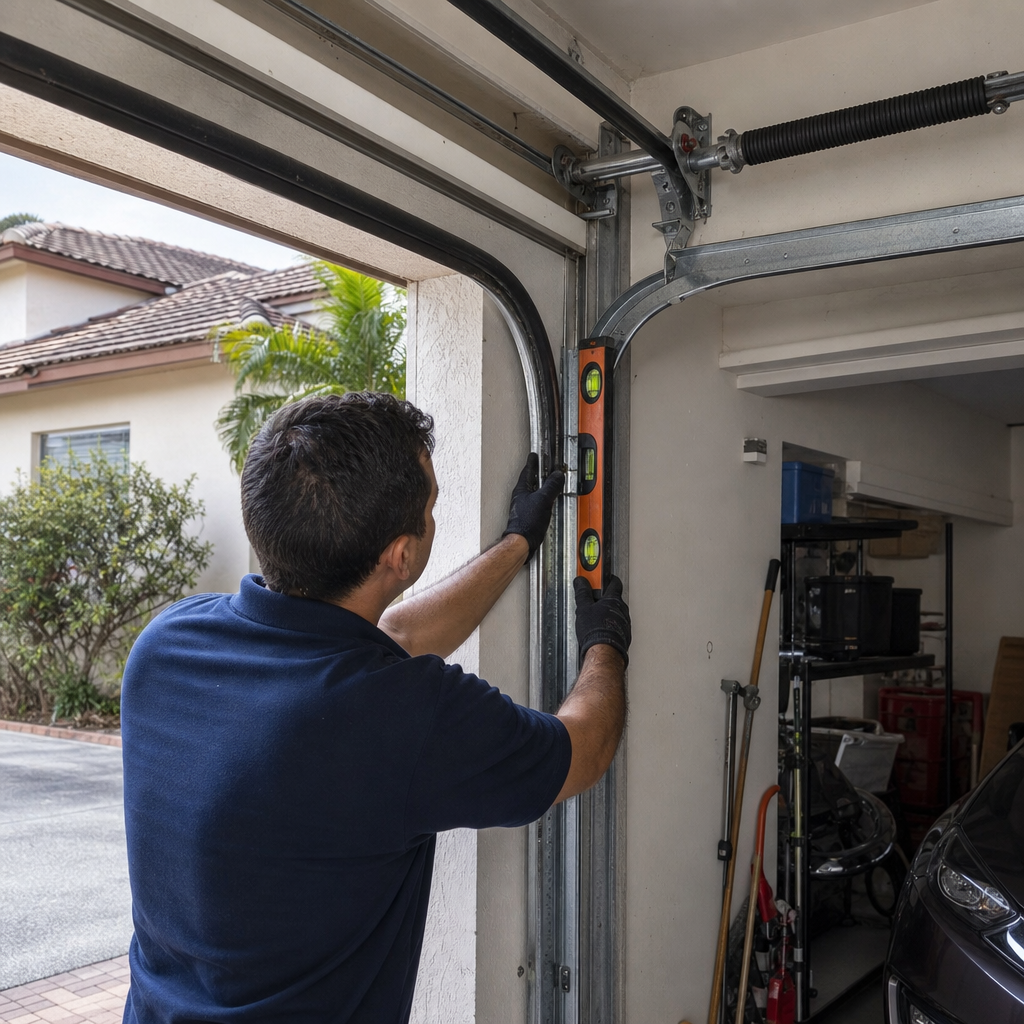
- New door installation requiring a Broward County permit — the permit, installation, and inspection should be handled by a licensed contractor.
Horizon Garage Door Repair offers free estimates throughout Fort Lauderdale. David Martinez personally handles diagnostic calls and stands behind every repair — no subcontractors, no guesswork. Call (561) 933-5484 to schedule, or visit our main Horizon Garage Door Repair Oakland Park home page for service details.
Frequently Asked Questions
How long do garage door springs last in Fort Lauderdale?
In Fort Lauderdale’s coastal environment, standard galvanized torsion springs typically last 18–30 months — significantly shorter than the 5–7 year lifespan they’d achieve in an inland climate. Upgrading to oil-tempered, galvanized springs with a heavier zinc coating, or specifying stainless steel springs for properties within a few blocks of salt water, extends service life to 4–8 years. Call (561) 933-5484 if you’re unsure what’s currently installed — a quick inspection is free.
Do I need a hurricane-rated garage door in Fort Lauderdale?
Yes. Broward County’s adopted Florida Building Code requires all new garage door installations to meet minimum wind-load ratings — typically 140 MPH or higher depending on your property’s wind zone. This applies to full replacements; repair-only work on an existing door is handled differently. Any new door must carry a verifiable Florida Product Approval number (FL#). If a contractor can’t provide that number before installation, don’t proceed.
How much does garage door installation cost in Fort Lauderdale?
A properly spec’d single-car door installation in Fort Lauderdale runs $950–$1,800 installed; a two-car hurricane-rated door with a quality opener runs $2,200–$3,800 depending on panel style, insulation rating, and opener brand. Big-box pricing looks lower because it typically excludes impact-rated hardware, marine-grade hardware upgrades, and permit costs. For a specific quote, call (561) 933-5484 — estimates are free and priced to this market, not a national average.
What’s the best garage door material for a home near the Fort Lauderdale beach?
For properties within two to three blocks of the ocean — areas like Lauderdale Beach, Harbor Beach, or the Coral Ridge waterfront — aluminum with an anodized coastal finish or fiberglass with a steel reinforcement frame are the strongest choices. Both resist salt-air corrosion far better than painted steel. If steel is preferred, specify 22-gauge minimum with a factory prime coat and high-grade topcoat, and plan for more frequent touch-up maintenance. Amarr and Clopay both manufacture coastal-spec options worth requesting by name.
Do I need HOA approval before replacing my garage door in Fort Lauderdale?
In most Fort Lauderdale HOA communities — and there are many, from Coral Ridge Country Club Estates to gated communities along Federal Highway — yes, written architectural committee approval is required before installation, not after. Submit the manufacturer’s spec sheet, confirm the FL# is included, and get written approval before ordering. A building permit from Broward County is also required for full replacements. A contractor who suggests skipping either step is cutting a corner that the homeowner will pay for later.
Can a garage door opener be damaged by Fort Lauderdale’s humidity?
Yes, though modern openers from LiftMaster, Chamberlain, and Genie are better sealed than older units. The real risk is in the circuit boards and drive components — salt-laden humidity accelerates corrosion on exposed metal contacts and can cause logic board failures within 3–5 years in high-exposure locations. Keeping the garage adequately ventilated, using a dehumidifier in detached garages, and choosing belt-drive openers (which have fewer exposed metal contact points than chain drives) all extend opener lifespan meaningfully. If your opener is malfunctioning in ways that seem electrical rather than mechanical, call for a diagnostic before buying a replacement — the fix is sometimes simpler than the symptom suggests.
The Bottom Line
Fort Lauderdale’s garage door market isn’t complicated — but it is specific. Salt air, hurricane-season wind loads, Broward County code requirements, and HOA processes create a set of decisions that generic advice gets wrong. The short version: spec for the climate, not the price tag. Choose materials rated for coastal exposure. Verify the FL# before you order anything. Get HOA approval in writing. Match the opener to the door’s actual weight. And maintain quarterly, not annually. A garage door system that’s correctly specified and maintained in Fort Lauderdale will outlast three rounds of cheaply installed alternatives — and it won’t strand you at 7 AM with a snapped spring.
If you want help getting the spec right from the start, David Martinez has been doing exactly this work in Fort Lauderdale for 12 years. Over 1,200 neighbors have trusted that experience. It tends to save them money the second time around — because there usually isn’t one.
For guidance on a new door, see our Garage Door Installation in Fort Lauderdale page. For repairs, diagnostics, or emergency service, call (561) 933-5484 — estimates are free, and David answers for every job personally.
Written by David Martinez, Owner & Lead Technician at Horizon Garage Door Repair Oakland Park, serving Fort Lauderdale since 2014.