
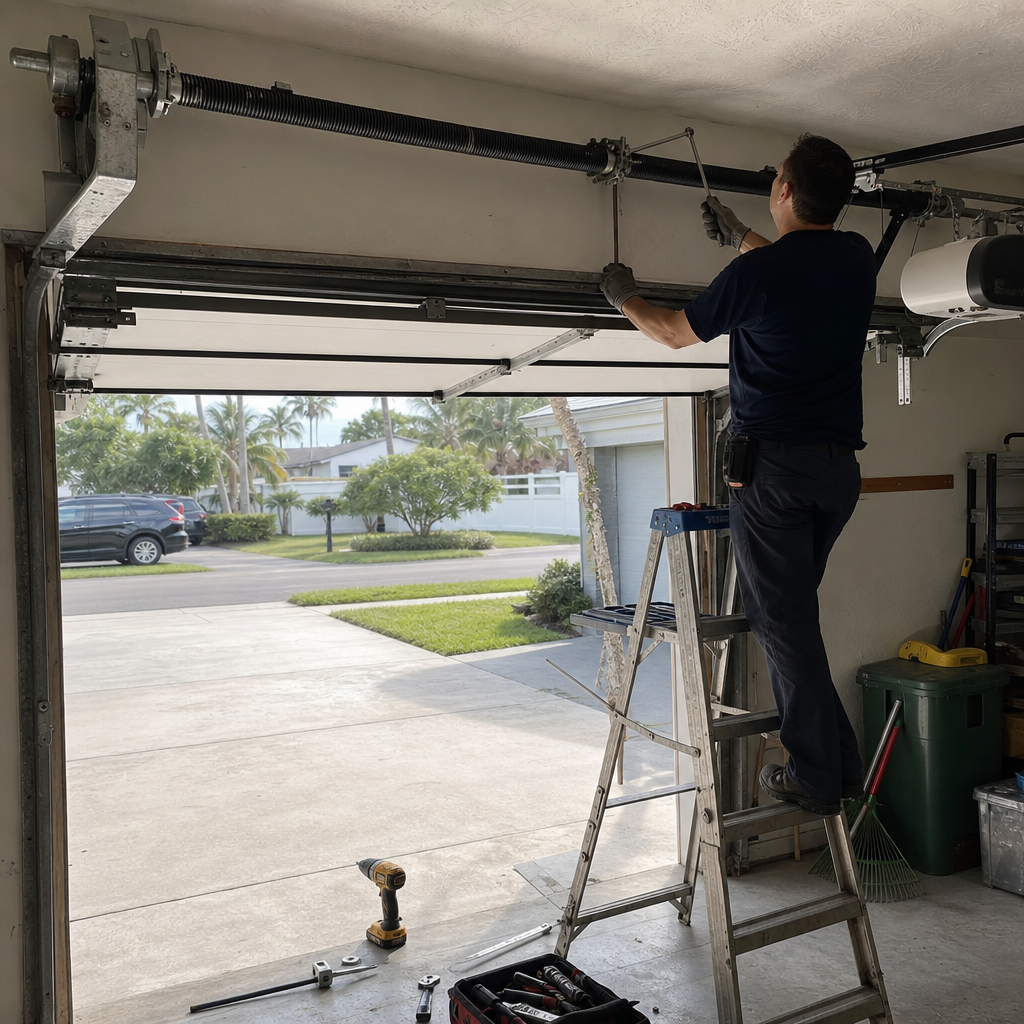
Last updated June 21, 2026
Garage Door Repair Maintenance Checklist for Fort Lauderdale Homeowners
The number-one avoidable service call David Martinez goes on in Fort Lauderdale isn’t a broken spring — it’s a corroded bottom seal that let moisture warp a door panel the homeowner could have replaced for $40 a year ago. South Florida doesn’t treat garage doors the way the rest of the country does. The combination of salt air blowing in from the Atlantic, humidity that rarely drops below 60%, hurricane-season wind loads, and six months of daily afternoon thunderstorms creates a maintenance environment that manufacturer PDFs written for Ohio or Minnesota simply don’t account for. This guide is built from 12 years of actual service calls in Fort Lauderdale — organized by what fails first here, why it fails, and exactly when to catch it before it costs you.
Quick Answer
Fort Lauderdale homeowners should perform garage door maintenance three times per year: in May before hurricane season, in November after storm season ends, and in February during the dry season for lubrication and hardware checks. The tasks that matter most in South Florida are bottom seal inspection, salt-corrosion checks on springs and cables, and applying a silicone-based lubricant rated for high heat — because the wrong product will gum up your hardware faster than the humidity will.
Table of Contents
- Why Fort Lauderdale Is Different From Every Other Market
- Your Three-Season Maintenance Schedule
- Bottom Seal and Weatherstripping: The Most Neglected Item in South Florida
- Salt Corrosion on Springs and Cables: What to Look For
- The Right Lubricant for Florida Heat — and What to Avoid
- Opener, Hardware, and Safety Sensor Inspection
- DIY Tasks vs. Leave-It-Alone Tasks: Where the Line Is
- Common Mistakes Fort Lauderdale Homeowners Make
- When to Call a Professional
- Frequently Asked Questions
- The Bottom Line
Why Fort Lauderdale Is Different From Every Other Market
Spend any time doing Garage Door Repair in Fort Lauderdale and one pattern becomes obvious: the failure modes here don’t match what the textbooks describe. Nationally, the top garage door killer is spring fatigue from thermal cycling — doors contracting in cold winters and expanding in summers. In Fort Lauderdale, we have no meaningful cold season, so spring fatigue is slower. What we do have is a moisture and salt environment that’s genuinely corrosive to metal components, rubber seals, and even powder-coated steel panels.
The neighborhoods closest to the water — Harbor Beach, Rio Vista, Las Olas Isles, Coral Ridge, and Lauderdale Harbors — see the most salt-air damage on cables and springs. But even inland areas like Lauderdale Lakes, Tamarac, and the areas feeding off Broward Boulevard aren’t immune. South Florida’s ambient humidity carries salt particulate well past the shoreline, and it settles on every exposed metal surface on your door.
Then there’s the hurricane factor. A door that was never rated for Broward County’s wind-load requirements, or one whose bottom seal has been compromised, can take on significant water during a named storm — or even a routine afternoon squall in July. The maintenance cadence in this guide is designed around that reality, not around a generic 12-month calendar written for a four-season climate.
Your Three-Season Maintenance Schedule
Fort Lauderdale’s year breaks into three garage door maintenance windows. Miss any one of them and you’re reacting to a failure instead of preventing it.
May — Pre-Hurricane Season Inspection
- Test the auto-reverse safety feature. Place a 2×4 flat on the ground beneath the door. The door should reverse immediately on contact. If it doesn’t, the force sensitivity on your opener needs adjustment — a LiftMaster or Chamberlain unit has this in the settings; a Genie or Craftsman unit may need a technician if the adjustment doesn’t hold.
- Inspect the bottom seal for cracks, gaps, or compression failure. Press the full length of the seal with your thumb. It should compress and spring back. Stiff, cracked, or flattened sections mean it won’t seat properly during a storm.
- Check all weatherstripping on the side and top of the door frame. Daylight visible from inside the garage is a failure — not a minor gap.
- Examine the torsion spring and cables visually for rust, fraying, or kinking. See the dedicated section below for what “early rust” looks like versus “dangerous rust.”
- Verify the door’s wind bracing if applicable. Doors installed in Broward County after 2002 should meet the Florida Building Code wind-load requirements. If your door is older and hasn’t been replaced, a pre-hurricane season check is the right time to evaluate it.
- Test manual operation. Disconnect the opener and lift the door by hand. It should feel balanced — not heavy on one side, not dropping when you release it halfway.
November — Post-Storm Season Check
- Rinse the door panels, springs, cables, and track with fresh water if you’ve had any significant storm activity. Salt deposits accelerate corrosion by an order of magnitude on wet metal.
- Inspect the bottom seal again. Wind-driven rain during a storm compresses the seal in ways normal operation doesn’t — check for tearing along the leading edge.
- Look at the track brackets and mounting hardware for any looseness caused by vibration during storms. Tighten 1/4-turn past snug on any bolt that moves.
- Check for panel warping or dents that might have come from wind debris. Even minor panel deformation can create gaps that compromise weather resistance.
- Lubricate all moving parts with the correct product (see the lubricant section below) — salt deposits and storm moisture are the fastest path to galling on rollers and hinges.
February — Dry Season Hardware and Lubrication Pass
- Full lubrication of all rollers, hinges, torsion spring, and bearing plates. February’s lower humidity makes this the ideal window — lubricant bonds better to clean, relatively dry metal.
- Tighten all visible hardware. Bolts on roller brackets, track mounts, and opener rail brackets vibrate loose over time.
- Test opener force settings and travel limits. Most LiftMaster and Chamberlain units have an indicator light sequence that signals if force settings are off.
- Clean the photo-eye sensors. Wipe the lens faces with a dry cloth. A dirty sensor causes intermittent reversals that homeowners often misdiagnose as an opener problem.
- Assess the door’s finish. Chalking, peeling, or bubbling paint on a steel door means the primer layer has failed and rust will follow within one season.
Bottom Seal and Weatherstripping: The Most Neglected Item in South Florida
If we had to name the single maintenance item that Fort Lauderdale homeowners neglect most often — and that causes the most downstream damage — it’s the bottom seal. This is the rubber or vinyl strip that runs the full width of the door’s bottom edge and contacts the garage floor when the door closes. It keeps water, insects, and debris out. In South Florida, it also prevents the kind of moisture intrusion that warps wood panels, corrodes steel panels from the inside, and grows mold on garage walls.
A quality replacement bottom seal runs $25–$60 in materials, depending on the door width and seal profile. The labor to swap it is minimal. The cost of replacing a warped door panel — or worse, a full door — starts at several hundred dollars and climbs quickly. We see this sequence regularly in areas like Sailboat Bend, Flagler Village, and Victoria Park, where older homes have original steel or wood doors that were never updated.
What to check:
- Run your hand along the bottom seal when the door is closed. Any section that feels stiff, brittle, or crumbles slightly is past its service life.
- Look for compression set — where the seal has flattened permanently and no longer forms a tight contact with the floor.
- Check the T-slot retainer (the channel the seal slides into) for corrosion or cracking. A damaged retainer means the replacement seal won’t seat properly.
- On the side and top weatherstripping, look for gaps where the frame has settled or where the vinyl has shrunk. Florida UV degrades vinyl weatherstripping faster than in northern climates — plan on replacement every 3–5 years.
Bottom seal replacement on a standard single-car door is a legitimate DIY task. Measure the door width, buy the matching profile (bulb, T-end, or beaded — check your current seal’s cross-section), and slide the new seal into the retainer channel. If the retainer itself is corroded or bent, that’s when you call us.
Salt Corrosion on Springs and Cables: What to Look For
Torsion springs and lift cables are the highest-stress components on your garage door. They’re also the most dangerous to handle and the most susceptible to salt-air corrosion in coastal South Florida. Understanding what you’re looking at — and knowing when to stop looking and start calling — is a genuinely useful skill.
Early-Stage Rust (Monitor Closely)
- Light surface discoloration — an orange or reddish-brown haze on the spring coils that wipes away with a cloth.
- Minor oxidation on the cable’s outer strands — looks like a brownish tint rather than bright steel.
- At this stage, a thorough cleaning and lubrication can slow progression significantly. Use a silicone-based lubricant, not WD-40 (see next section).
Intermediate Rust (Schedule Replacement Soon)
- Visible pitting on the spring wire — small craters or rough spots you can feel when you run a gloved finger across the coil.
- Cable strands that look dark, stiff, or slightly kinked rather than smooth and flexible.
- At this stage, the tensile strength of both components has been compromised. Keep operating the door, but schedule a professional inspection within 30 days.
Advanced Rust (Stop Using the Door)
- Spring coils that are visibly separating, have deep grooves eaten into the wire, or show any crack-like lines along the coil body.
- Cable strands that are visibly broken — even one frayed or separated strand means the cable has failed and the full cable set needs replacement immediately.
- A snapped torsion spring releases stored energy equivalent to a significant impact force. Don’t operate the door. Call a professional.
In waterfront Fort Lauderdale zip codes — 33316, 33301, 33304 — we typically see springs reach intermediate rust stage 18–24 months sooner than in inland Broward County neighborhoods. Factor that into your inspection frequency if you’re east of Federal Highway.
The Right Lubricant for Florida Heat — and What to Avoid
This is the section where we see the most well-intentioned homeowners accidentally cause damage. Hardware store shelves in Fort Lauderdale are full of lubricants that work perfectly well in moderate climates and actively attract grit in South Florida’s conditions.
Use These
- White lithium grease (in a spray can): Excellent for rollers, hinges, and the torsion spring. Stays put in Florida heat, doesn’t run or migrate, and doesn’t become tacky in humidity.
- Silicone-based spray lubricant: The right choice for the torsion spring coils and any plastic components on the opener rail. It’s heat-stable, doesn’t attract dust, and won’t degrade rubber seals or nylon rollers.
- Garage door-specific lubricants from LiftMaster or Genie are formulated for exactly these conditions — if you have either brand’s opener, their branded lubricant is worth the slight premium.
Avoid These
- WD-40: It’s a water displacer and solvent, not a lubricant. It will temporarily stop a squeak, then leave a residue that attracts every particle of South Florida road dust and fine grit. Within a few weeks, your rollers will sound worse than before.
- Standard motor oil or 3-in-1 oil: Too thin for the heat — it migrates off the surface quickly and leaves an oily track that collects debris in the track.
- Grease on the tracks: A common mistake. Tracks should be clean and free of lubricant. The rollers ride in the track — lubricating the track surface causes rollers to slip and collect grime. Wipe tracks clean with a dry cloth; lubricate only the roller stems and hinges.
Opener, Hardware, and Safety Sensor Inspection
Your opener works harder in Fort Lauderdale than it would in most of the country. Heat affects the motor’s thermal protection circuit, humidity affects circuit boards, and power fluctuations during afternoon storm season stress the electronics. Whether you’re running a LiftMaster belt drive, a Chamberlain chain drive, a Genie screw drive, a Wayne Dalton TorqueMaster unit, or an Amarr, Clopay, Craftsman, or Raynor door with any compatible opener, these checks apply across the board.
Opener checks to perform twice yearly:
- Photo-eye sensor alignment: The two sensors at the bottom of the door tracks must face each other squarely. A blinking light on the opener’s motor unit (often amber on LiftMaster/Chamberlain) indicates misalignment or obstruction.
- Force and travel limit settings: If the door doesn’t fully close, strains audibly on the way up, or reverses for no visible reason, force or travel settings have drifted. Most modern openers allow you to adjust this without tools.
- Wall button and remote responsiveness: Lag, intermittent response, or the need to press twice usually signals a dying battery in the remote — but can also indicate a logic board issue beginning to develop.
- Surge protection: If your opener isn’t on a surge protector, add one. Power spikes during Fort Lauderdale’s afternoon thunderstorm season are a real threat to opener circuit boards. A $15 surge strip is meaningfully cheaper than a replacement logic board.
- Rope and emergency release: Pull the red emergency release cord monthly and verify the door disengages smoothly. In a power outage during a storm, this is your only way out.
For new opener options or if your current unit is aging, our Garage Door Opener in Fort Lauderdale page covers what we recommend for South Florida homes specifically.
DIY Tasks vs. Leave-It-Alone Tasks: Where the Line Is
We’re straightforward about this because the stakes are real. Some maintenance tasks are genuinely safe and cost-effective for a capable homeowner. Others carry real injury risk or can create significantly worse problems if done incorrectly. Here’s the honest breakdown:
Safe for a Capable DIYer
- Bottom seal replacement (sliding the seal into the retainer channel)
- Weatherstripping replacement on the door frame
- Lubrication of rollers, hinges, and torsion spring
- Tightening loose hardware bolts (don’t overtighten — snug plus a quarter turn)
- Cleaning photo-eye sensors
- Replacing opener remote batteries and reprogramming remotes
- Rinsing door panels and hardware with fresh water after storms
- Visual inspection of all components and noting what needs attention
Call a Professional — Always
- Torsion spring adjustment or replacement: This is the non-negotiable one. A torsion spring under tension stores significant mechanical energy. Improper handling causes serious injury. The tools required are specific and the technique is learned through repetition, not a YouTube video. David Martinez has performed this repair hundreds of times — it’s still handled with deliberate care every single time.
- Cable replacement or adjustment: Cables are directly connected to the spring system’s tension. Adjusting one without understanding how it interacts with the drum and spring creates unpredictable load distribution.
- Track realignment beyond minor adjustments: If a track section has moved significantly or the door is visibly off-plumb, the underlying bracket and mounting may be compromised.
- Opener logic board or wiring repairs: Garage door opener electronics operate on household current. Unless you’re a qualified electrician, the circuit board is not a DIY component.
- Any repair you’re not fully confident in: A door that operates incorrectly after an attempted repair is more dangerous — and more expensive to fix correctly — than one that was left alone.
If you’re planning a new door and want to understand what installation involves, our Garage Door Installation in Fort Lauderdale page walks through the full process.
Common Mistakes Fort Lauderdale Homeowners Make
- Using WD-40 as a lubricant on rollers and springs. As described above, it removes existing lubrication and leaves a residue that collects South Florida’s fine road dust and salt grit. Rollers that squeaked begin grinding within weeks. Use white lithium grease or silicone spray instead.
- Ignoring the bottom seal until after a flooding event. In neighborhoods like Croissant Park or Edgewood that can see standing water during heavy rain events, a failed bottom seal turns a minor storm into a water damage claim. The seal is a $30–$60 fix; remediation is a $1,000+ problem.
- Lubricating the tracks instead of the rollers. Greasy tracks collect debris, cause rollers to slip, and make the door noisier over time — the opposite of the intended result. Tracks should be clean; the roller stems and hinges are what get lubricated.
- Running a door on a broken or heavily corroded spring. A spring that’s weakening puts the full load burden on the opener motor. Most residential openers aren’t designed to lift an unbalanced door repeatedly — the motor overheats and the logic board can fail. What started as a $180–$250 spring repair becomes a $300–$450 opener replacement on top of it.
- Skipping the pre-hurricane inspection. Fort Lauderdale homeowners who don’t check door balance, bottom seal condition, and hardware integrity before June 1 are gambling on a Broward County hurricane season that’s produced named-storm impacts in recent years. A door that was borderline in April can fail entirely under wind load in August.
- Attempting torsion spring adjustment from online tutorials. We understand the impulse — spring replacement looks manageable on video. What videos don’t show is the variance in spring tension across different door weights, or what happens when a winding bar slips. This is the one task where the call to a professional is unambiguously the right choice.
- Painting over rust spots on springs or cables. Cosmetically it looks better, but paint over corroded steel traps moisture and accelerates subsurface corrosion. If there’s rust on your springs, the right answer is lubricant for early-stage rust or replacement for intermediate-to-advanced rust — not paint.
When to Call a Professional
Call a professional immediately if your torsion spring has snapped — the door will be noticeably heavy and may not open at all, which is the tell. The same applies to any cable that appears frayed, kinked, or has visibly separated strands. Both of these are safety-critical components that store or manage significant mechanical loads.
Schedule a professional inspection (not an emergency call, but soon) when your door is slow or labored on the way up, when it reverses for no visible reason, when you hear grinding rather than smooth rolling, or when the door looks visibly uneven in the opening. These are early warnings, not emergencies — but they become emergencies if ignored.
If you’ve gone through the checklist above and you’re not sure what you’re looking at, an inspection call is the right move. We’ve been serving Fort Lauderdale for 12 years, and David shows up personally — you’re not getting a subcontractor who’s never seen your door before. Horizon Garage Door Repair offers free estimates — call (561) 933-5484 and we’ll give you a straight answer about what your door actually needs.
Frequently Asked Questions
How often should I lubricate my garage door in Fort Lauderdale?
Lubricate your garage door’s rollers, hinges, springs, and bearing plates at least twice per year in Fort Lauderdale — once in February during the dry season and once in November after hurricane season. If you’re in a waterfront neighborhood like Harbor Beach, Las Olas Isles, or Coral Ridge, consider adding a third pass in May before the rainy season begins. Salt-air environments accelerate wear on unlubricated metal faster than most homeowners expect. Call (561) 933-5484 if you’d like us to handle the full lubrication and inspection in one visit — estimates are free.
What kind of lubricant should I use on a garage door in South Florida?
Use white lithium grease spray for rollers and hinges, and silicone-based lubricant for torsion springs and any nylon or plastic components. Both products stay stable in South Florida’s heat and don’t attract grit the way petroleum-based products do. Avoid WD-40 — it’s a solvent and water displacer, not a lubricant, and it leaves a residue that collects the fine dust and salt particulate that’s constantly in Fort Lauderdale’s air.
How do I know if my garage door bottom seal needs replacing?
Press firmly along the full length of the seal when the door is closed. If any section feels hard, brittle, crumbles slightly, or has visibly flattened and no longer springs back, replace it. Also check for daylight visible under the door from inside the garage — any gap means the seal has failed at that point. In South Florida, plan on replacing the bottom seal every 3–5 years, and sooner if the door faces direct sun most of the day. A replacement seal typically costs $25–$60 in materials for a standard-width door.
Is it safe to use my garage door if the spring looks rusty?
It depends on the stage. Light surface discoloration that wipes off — an orange haze on the coils — is early-stage rust and the door is safe to use with prompt lubrication and monitoring. Visible pitting, rough spots you can feel on the wire, or darkened and stiff cable strands mean intermediate rust — continue using the door but schedule a professional inspection within 30 days. If spring coils are visibly separating, deeply grooved, or cracked, or if any cable strand is broken, stop using the door and call immediately. Operating a compromised spring risks sudden failure. Call (561) 933-5484 for a free assessment.
What maintenance should I do before hurricane season in Fort Lauderdale?
Before June 1, complete this five-point check: inspect and replace the bottom seal if it’s compressed or cracked; test door balance by disconnecting the opener and lifting manually (it should stay at the halfway point without drifting); check weatherstripping for gaps; inspect springs and cables visually for corrosion; and verify the door’s wind-load rating if it was installed before 2002. A door that can’t seat properly during a storm or that doesn’t meet Broward County’s wind-load requirements is both a water damage risk and a structural liability. We see the aftermath of skipped pre-season checks every November — it’s avoidable.
Which garage door brands does Horizon Garage Door Repair service in Fort Lauderdale?
We service all eight major residential brands: LiftMaster, Chamberlain, Genie, Clopay, Amarr, Wayne Dalton, Craftsman, and Raynor. David Martinez is factory-trained across all of them, which means virtually no job requires a second visit or an outside referral. If you’re not sure what brand your door or opener is, that’s fine — we can identify it on arrival and have the relevant parts on hand for most common repairs. Call (561) 933-5484 for a free estimate.
The Bottom Line
A well-maintained garage door in Fort Lauderdale lasts significantly longer and fails far less often than one that gets attention only when something breaks. The three-season schedule in this guide — May pre-hurricane, November post-storm, February dry-season lubrication — maps directly to the conditions that actually damage doors in South Florida. The bottom seal, the springs, and the lubricant choice are the three variables that separate homeowners who call us for a $40 seal from homeowners who call us for a $400 panel replacement. Do the visual checks. Use the right lubricant. Replace the seal on schedule. And for anything involving spring tension or cables, make the call — that’s genuinely not the place to experiment. Over 1,200 Fort Lauderdale neighbors have trusted us with exactly these situations. We’d be glad to help with yours.
Ready for a professional inspection or repair? David shows up and stands behind every job personally. Call Horizon Garage Door Repair at (561) 933-5484 for a free estimate — no pressure, no runaround, just a straight answer about what your door needs. You can also learn more about our full range of services at the Horizon Garage Door Repair Oakland Park home page.
Written by David Martinez, Owner & Lead Technician at Horizon Garage Door Repair Oakland Park, serving Fort Lauderdale since 2014.